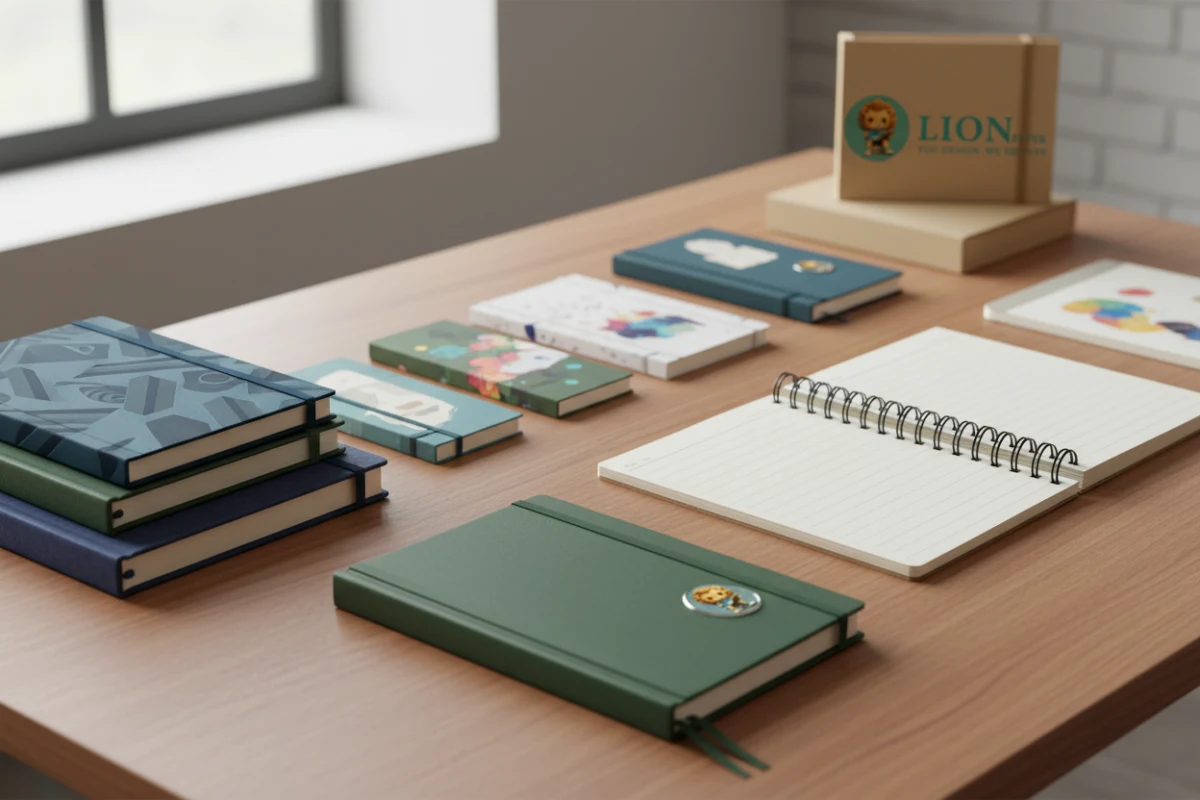
How Page Count Affects Custom Notebook Cost, Thickness, Binding, and User Experience
For bulk notebook buyers, page count directly dictates paper cost, spine thickness, binding options, shipping weight, and overall retail value, making it a critical balance between user experience and landed cost. Choosing the right page count is not just a design choice; it is a structural and financial decision that determines the feasibility of your custom notebook project.
How Do Page Count and Notebook Paper Weight GSM Define Notebook Thickness?
The physical thickness of a notebook is determined by two main factors: the page count (number of sheets) and the notebook paper weight GSM (Grams per Square Meter). Higher GSM paper is thicker and more opaque, meaning a notebook with fewer pages of heavy paper can be just as thick as one with more pages of thin paper.
To calculate the approximate notebook thickness and shipping weight, manufacturers use the caliper of the paper. Below is a comparison table illustrating how page count and paper weight combine to affect the overall thickness of a notebook spine (excluding the cover):
| Page Count (Pages / Sheets) | Paper Weight (GSM) | Typical Paper Type | Estimated Spine Thickness (Excl. Cover) | Est. Weight per A5 Book |
|---|---|---|---|---|
| 96 Pages (48 Sheets) | 80 GSM | Offset Woodfree | ~4.8 mm | ~150g |
| 160 Pages (80 Sheets) | 80 GSM | Offset Woodfree | ~8.0 mm | ~240g |
| 160 Pages (80 Sheets) | 100 GSM | Premium Ivory | ~10.4 mm | ~300g |
| 192 Pages (96 Sheets) | 120 GSM | Heavy Sketch | ~14.4 mm | ~420g |
| 240 Pages (120 Sheets) | 80 GSM | Standard Lined | ~12.0 mm | ~360g |
 How page count and paper weight (GSM) directly determine the final spine thickness of custom notebooks.
Which Custom Notebook Binding Options Work Best with Different Page Counts?
Your chosen page count severely limits or enables specific custom notebook binding options. Selecting an incompatible binding for your page count can lead to split spines, falling pages, or notebooks that refuse to lay flat.
- Saddle-Stitch Binding: Ideal for low page counts (32 to 64 pages). Anything thicker will cause the notebook to "gush" open and not lie flat.
- Wire-O and Spiral Binding: Highly versatile, accommodating 50 to 240+ pages. The manufacturer simply adjusts the coil diameter to match the notebook thickness.
- Perfect Bound (Softcover): Requires a minimum thickness, usually at least 64 pages (32 sheets), to ensure the glue has enough surface area on the spine to hold securely.
- Case Bound (Hardcover): Typically optimized for 120 to 240 pages. Lower page counts look too thin for a premium hardcover, while excessive page counts make the book heavy and prone to spine cracking under its own weight.
How Does Page Count Impact the Bulk Notebook Manufacturing Cost?
When calculating the bulk notebook manufacturing cost, the page count affects both direct material utilization and production efficiency.
- Material Costs: Paper typically represents 50% to 60% of the raw material cost of a notebook. Doubling the page count from 96 to 192 pages nearly doubles your inner-page paper costs.
- Signature Printing Blocks: In commercial offset printing, pages are printed on large sheets called "signatures" (usually in multiples of 16 or 32 pages). Designing a notebook with a page count that is not a multiple of 16 (e.g., 150 pages) leads to paper waste and manual assembly steps, which inflates the page count custom notebook cost.
- Production Speed: Extremely thick notebooks require longer binding press times and slower cooling periods for glue-based bindings, increasing labor costs per unit.
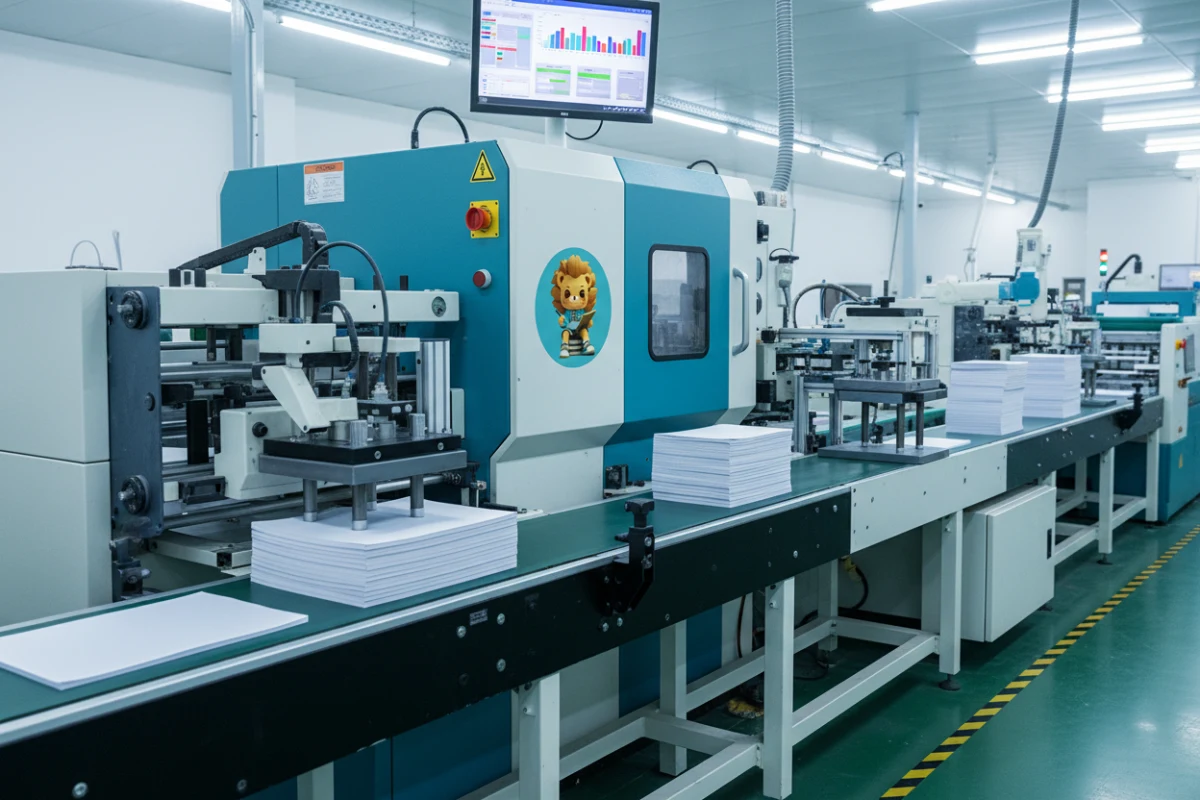 Inside our automated production facility, where binding options are optimized for precise page counts.
How Do Notebook Thickness and Shipping Weight Affect Freight Economics?
Shipping and logistics can make or break the profitability of a custom notebook import project. Because notebooks are dense paper products, they are highly sensitive to weight-based shipping tariffs.
An increase in page count directly escalates the notebook thickness and shipping weight, impacting transport costs in two major ways:
- FCL/LCL Ocean Freight: Heavy shipments can reach legal road weight limits before filling the physical volume of a shipping container. A container packed with 240-page notebooks will hit weight limits much faster than one packed with 96-page journals.
- Courier and Air Freight: For Amazon sellers, DTC brands, or fast-turnaround promotional events, air freight is billed by chargeable weight. A 160-page notebook with 100 GSM paper can cost double to air-ship compared to a 96-page notebook with 80 GSM paper.
How to Select the Perfect Page Count for Different Target Users?
The ideal page count depends heavily on how and where your target audience will use the stationery. Tailoring the specifications ensures a positive user experience without overpaying for unused paper.
- Pocket Notebooks & Field Journals (32 - 64 Pages): Best suited for lightweight, on-the-go note-taking. These thin profiles slip easily into pockets or small bags.
- Standard Office & Meeting Notebooks (96 - 128 Pages): The sweet spot for corporate branding, conference giveaways, and daily office tasks. It offers a professional feel while maintaining low shipping costs.
- Creative Journals, Diaries & Planners (160 - 240 Pages): Preferred by bullet-journaling enthusiasts, students, and retail brand consumers who write daily and value a premium, thick, and durable notebook.
 Optimized page counts and correct binding selections allow notebooks to lie perfectly flat for an enhanced user experience.
Why Partner with Lion Paper for Custom Notebook Manufacturing?
At Lion Paper Products, we help global brands, retailers, and e-commerce sellers navigate the complex trade-offs between page count, material weight, binding durability, and shipping logistics.
Operating dual-location manufacturing facilities in Jiaxing, China, and Cambodia, we provide end-to-end supply chain support. Whether you need rapid prototyping and structural design advice in China or cost-effective, tariff-exempt mass production in Cambodia, our automated production lines guarantee consistent quality. We help you choose the exact GSM and page configuration to optimize your overall landed costs.
Ready to engineer the perfect product for your brand? Optimize page count and cost with Lion Paper today.