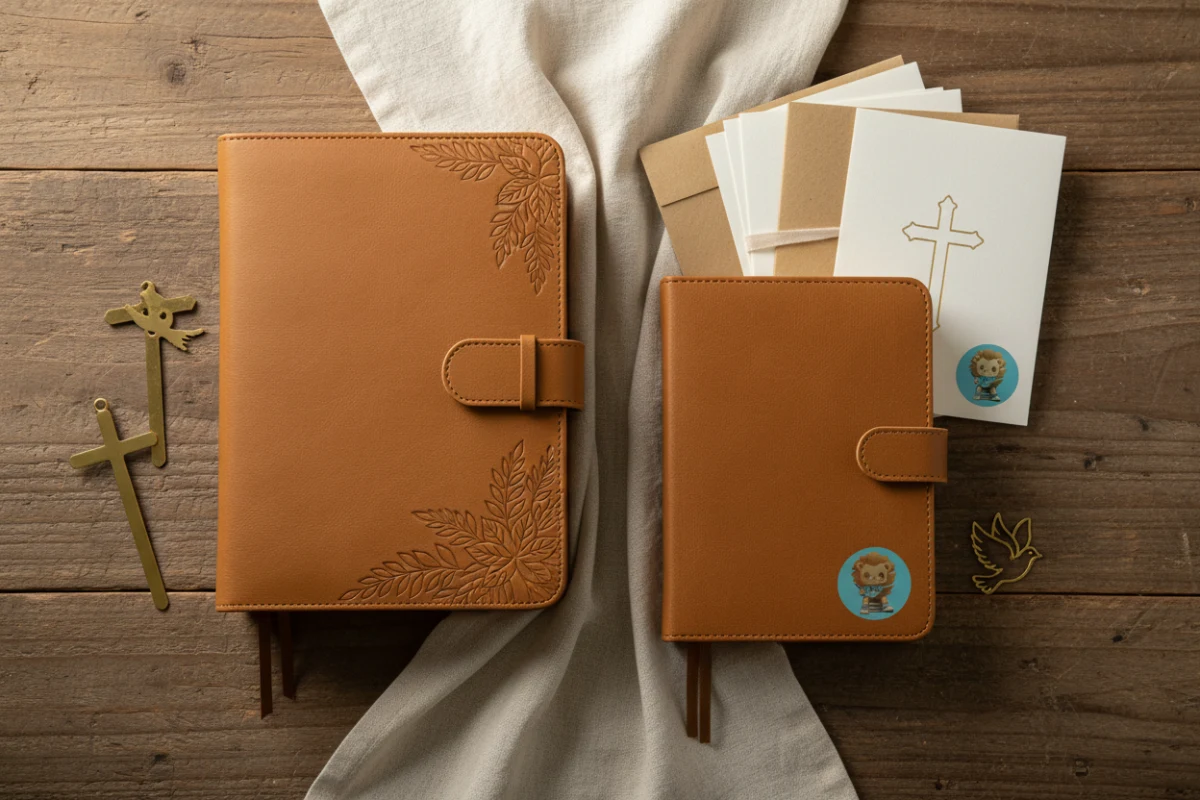
The Strategic Guide to Religious Gift Collection Development: Beyond the Bible Cover
Beyond the Bible Cover: The Commercial Drivers of Religious Gift Collection Development
In the modern inspirational and faith-based products market, consumer buying behavior has undergone a profound shift. Historically, buyers sought out functional, standalone products—a single protective cover, a standard leather Bible, or a simple devotional pamphlet. Today, however, the market is driven by lifestyle integration and aesthetic curation. Modern consumers seek beautifully designed, highly cohesive product ecosystems that reflect their identity, elevate their daily study routines, and serve as premium, ready-to-give presents for life's major milestones.
For Christian brands, religious publishers, and global gift retailers, this behavioral evolution represents an extraordinary commercial opportunity. Relying on a single product, such as a standalone Bible cover, limits customer touchpoints and caps transactional value. Conversely, embarking on a deliberate strategy of religious gift collection development allows brands to transform their product portfolios into unified lifestyle experiences. By building an interconnected ecosystem of products, brands can seamlessly guide a customer who initially seeks a protective cover toward a matching prayer journal, coordinated study accessories, and elegant writing tools.
From a strict B2B merchandising perspective, executing a structured collection development strategy addresses several critical commercial objectives:
- Maximizing Average Order Value (AOV): Cohesive, themed product lines naturally encourage bundling and cross-category purchasing, prompting retail buyers and end consumers to purchase complete sets rather than individual SKUs.
- Securing High-Margin Opportunities: While core commodities like Bibles or standard utility covers face intense price competition, complementary items—such as specialty paper stationery, custom bookmarks, and gift packaging—command much higher retail margins.
- Differentiating on the Retail Shelf: A coordinated, visually striking collection creates a powerful physical and digital shelf presence, helping brands stand out in crowded online marketplaces and brick-and-mortar boutique displays.
- Fostering Long-Term Brand Loyalty: When customers find an aesthetic and functional ecosystem that resonates with their lifestyle, they return season after season to purchase new releases, holiday extensions, or matching gifts for family and friends.
To capture this potential, brands must move away from fragmented sourcing and embrace a holistic approach to design-to-manufacturing integration. Success requires a sophisticated understanding of product architecture, strict material standards, and an agile supply-chain partner capable of delivering consistent quality across diverse product categories.
The Product Expansion Roadmap: From Core Anchor to Full Retail Portfolio
Building a successful collection requires a logical, phased approach to product expansion. Rather than launching a disparate array of random items under a single brand label, successful brands construct their product lines using a structured four-stage development funnel. This methodology ensures that each new product naturally supports and elevates the existing portfolio.
+-------------------------------------------------------------+
| 1. THE ANCHOR SKU (The Foundation)                         |
|    High-durability, premium Bible covers & book protection   |
+-------------------------------------------------------------+
                              |
                              v
+-------------------------------------------------------------+
| 2. DAILY COMPANION PRODUCTS (Habit Integration)             |
|    Guided prayer journals, scripture notebooks, planners     |
+-------------------------------------------------------------+
                              |
                              v
+-------------------------------------------------------------+
| 3. BUNDLED ACCESSORIES (Add-on Customization)               |
|    Pen cases, custom bookmarks, study tabs, sticky notes    |
+-------------------------------------------------------------+
                              |
                              v
+-------------------------------------------------------------+
| 4. GIFT SETS & PACKAGING (The Premium Upsell)               |
|    Rigid presentation boxes, themed kits, holiday bundles   |
+-------------------------------------------------------------+
Phase 1: Establish the Anchor
Every great collection begins with a high-trust anchor product. In this segment, the anchor is almost always the Bible cover. Because it protects a deeply personal and frequently used text, the cover is held to incredibly high functional standards. By partnering with a dedicated Bible cover manufacturer, brands can establish their reputation for premium material selection, heavy-duty zipper hardware, and precise dimensional fitting. This initial product builds the consumer confidence necessary to support future brand extensions.
Phase 2: Integrate Daily Companion Products
With a trusted anchor established, the next logical step in religious gift collection development is introducing products designed for daily spiritual habits. This is where Christian stationery products become essential. Guided prayer journals, weekly reflection planners, and scripture notebooks invite the user into a daily interaction with the brand. These products are high-touch, visually expressive, and naturally consumable, requiring replenishment on an annual or seasonal basis.
Phase 3: Introduce Add-On Bible Accessories
To complete the daily study experience, brands should expand into smaller, high-margin Bible accessories. Items such as matching pen pouches, slide-in bookmarks, sticky-note tabs, and coordinating sticker sets require minimal retail shelf space but provide substantial incremental revenue. These accessories allow consumers to customize their study setups while maintaining a completely unified visual aesthetic.
Phase 4: Package into Curated Gift Sets
The final phase of product expansion combines the anchor, the companions, and the accessories into retail-ready gift sets. Gift buyers, particularly during Christmas, spring graduation, confirmation, and Mother's Day, prioritize convenience and high-perceived value. An elegantly boxed set containing a matching Bible cover, daily planner, and metal bookmark simplifies the purchasing decision and commands a significant retail premium.
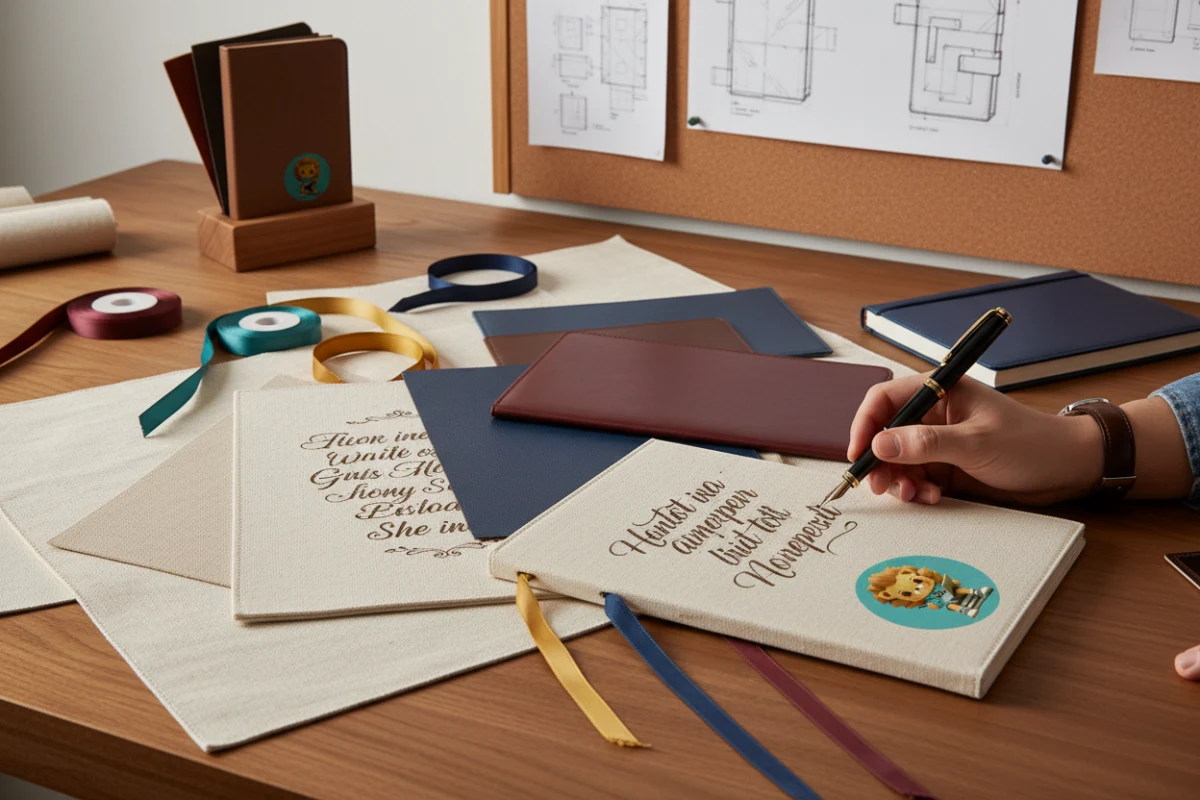
Designing for the Faith-Based Market: Visual Unity and Aesthetic Cohesion
Unlike utility-driven consumer products, faith-based gifts rely heavily on emotional resonance, personal values, and aesthetic elegance. To make a collection feel intentional and premium, every product must share a cohesive design language. This level of visual integration requires careful attention to three core design pillars:
1. Trend-Forward Color Palettes
Modern faith-based brands have moved past generic, high-contrast colors in favor of sophisticated palettes that mirror contemporary fashion and interior design trends.
- Earthy Organics: Soft terracotta, muted sage greens, warm sand, and charcoal tones appeal to buyers seeking a grounded, peaceful, and organic lifestyle aesthetic.
- Monastic & Heritage: Deep slate gray, rich forest green, royal navy, and classic burgundy evoke a sense of scholarly study, tradition, and intellectual depth.
- Modern Feminine: Delicate blush pink, lavender grey, linen cream, and soft champagne-gold accents are highly effective for women-forward journaling lines.
2. Understated, Minimalist Imagery
Today’s consumers favor clean typography, delicate botanical motifs (such as olive branches, mustard seeds, or wildflowers), and minimalist geometric layouts over loud, overly busy designs. Carrying a single, beautifully rendered motif consistently across multiple products—such as debossed on the front leather of a Bible cover, printed on the inner lining of a pen case, and hot-stamped on a journal’s endpapers—creates a powerful sense of unity.
3. Cross-Substrate Color Matching
One of the most challenging aspects of religious gift collection development is achieving consistent visual execution across completely different materials. A specific shade of sage green must look identical whether it is dyed into a cotton-canvas Bible cover, printed on FSC-certified paper, or hot-stamped onto vegan leather. Successfully managing this cross-substrate color matching requires a manufacturing partner with integrated engineering capabilities, ensuring that dyes, ink pigments, and foil temperatures are carefully calibrated across different production lines.
Material Engineering and Compliance in Modern Gift Production
High-value gift collections are inherently tactile. The smooth glide of a brass zipper, the supple feel of a cover material, and the weight of a journal's page all contribute to the consumer's perception of quality. Selecting the right materials is crucial for both aesthetic appeal and long-term durability.
| Material Category | Application in Collections | Tactile & Performance Features | Sustainability & Retail Compliance |
|---|---|---|---|
| Premium PU & Vegan Leathers | Bible covers, hardcover journals, pencil cases, magnetic bookmarks | Soft hand-feel, rich grain patterns, highly receptive to deep blind debossing | Cruelty-free, compliant with international chemical standards (REACH, CPSIA) |
| Natural Canvas & Linen Textiles | Casual Bible covers, tote bags, utility pouches, notebook spine wraps | High durability, raw organic texture, ideal for screen printing and delicate embroidery | Biodegradable, can utilize certified organic cotton to target eco-conscious buyers |
| FSC-Certified Fine Papers | Inner pages of journals, planners, greeting cards, note cards | Smooth writeability, bleed-resistant (100gsm–120gsm options), zero ink ghosting | 100% traceable, sourced from responsibly managed forests, FSC-certified |
| Recycled & Rigid Greyboard | Gift presentation boxes, rigid slipcases, structural backing board | Exceptional rigidity, high crush-resistance during transit and retail display | Utilizes post-consumer recycled waste, supporting circular economy initiatives |
In addition to sensory appeal, commercial compliance is a non-negotiable requirement when pitching to major retail chains, supermarkets, and international publishers. Leading global distributors require strict adherence to international social, environmental, and quality standards.
Sourcing materials through an audited supply chain ensures that your products are free of hazardous chemicals, ethically manufactured, and fully traceable. Partnering with a manufacturer that possesses certifications like ISO 9001, FSC, SMETA, and WCA allows your brand to enter mainstream retail markets with complete confidence and zero compliance risk.
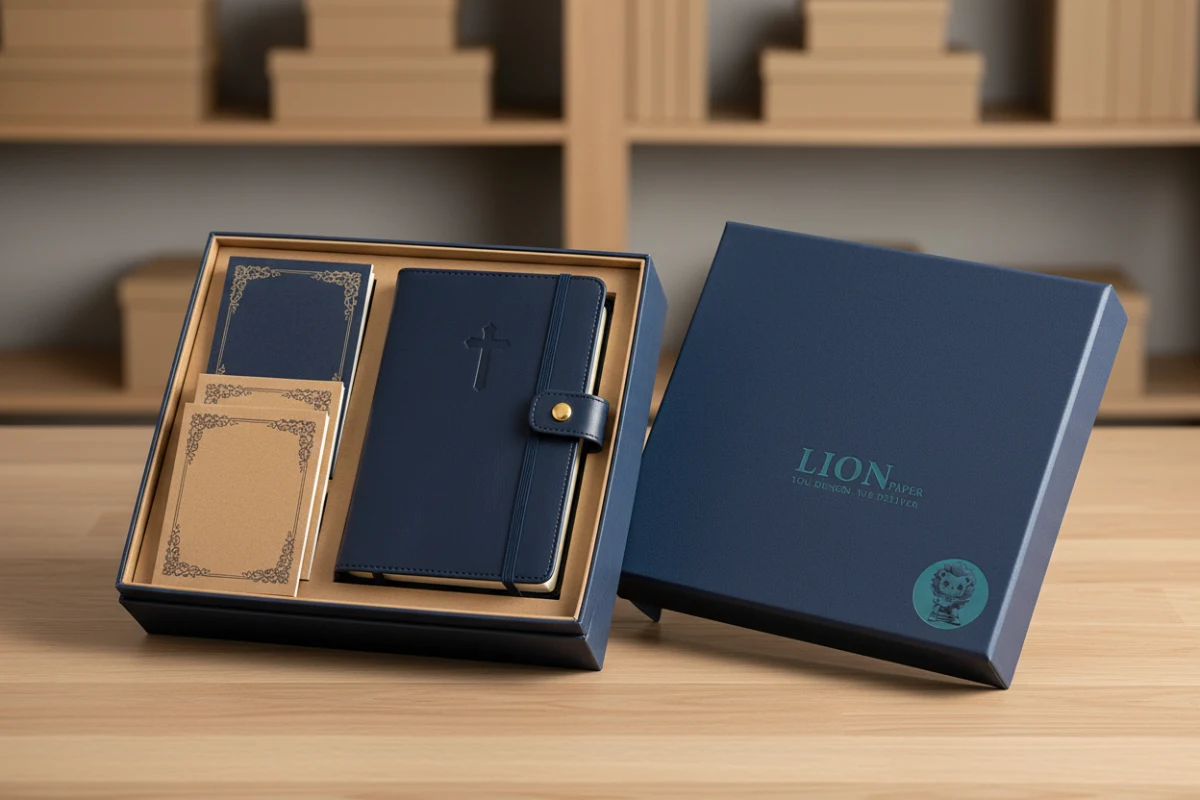
The Strategic Role of Retail-Ready Packaging and Gift Bundling
In the luxury gift industry, the unboxing experience is an integral part of the product itself. High-quality packaging not only protects the contents during transit but also serves as a key driver of retail purchasing decisions and online consumer reviews. When developing a comprehensive faith-based gift line, brands should plan their packaging strategies alongside their product designs:
- Magnetic-Closure Presentation Boxes: Best suited for high-tier gift sets, such as a matching Bible cover, prayer journal, and writing pen. The solid weight and satisfying magnetic snap create an immediate impression of luxury.
- Rigid Slipcases: An excellent choice for book-and-journal sets. A custom-fit slipcase keeps multiple items neatly bundled on retail shelves, prevents edge damage, and stands upright for clean shelf display.
- Belly Bands and Sleeve Wraps: A highly cost-effective option for bundling smaller paper stationery items, such as a set of three coordinating scripture notebooks. Printed on textured, eco-friendly paper, belly bands provide ample space for branding and product information without adding excessive cost.
- Counter-Top Display Units (CDUs): For smaller Bible accessories like bookmarks, sticky notes, or magnetic clips, customized cardboard CDUs encourage spontaneous, last-minute impulse purchases at retail cash registers.
Beyond aesthetics, structural packaging engineering must prioritize logistics efficiency. Well-designed packaging minimizes empty volume, reducing international shipping costs, and protects delicate corners from being crushed during long-distance shipping and warehouse handling.
Dual-Base Manufacturing: Mitigating Supply Chain Risks and Optimizing Landed Costs
In today's complex global trade environment, relying on a single manufacturing source can expose brands to significant risks, including supply-chain disruptions, shipping delays, and unpredictable tariff fluctuations. To maintain a competitive edge, brands require a manufacturing partner with a flexible, multi-node production footprint.
This is where the unique dual-site synergy of Lion Paper Products provides a massive strategic advantage for global brands. By combining the strengths of an advanced design facility in Jiaxing, China, with a large-scale mass-production plant in Cambodia, Lion Paper offers a seamless, risk-mitigated supply-chain bridge:
1. Rapid Development and Prototyping (Jiaxing, China)
The 3,000-square-meter Jiaxing facility serves as the creative and technical heart of the operation. Here, specialized design, engineering, and prototyping teams collaborate closely with brands to turn initial concepts into reality. With advanced equipment and a vast library of materials, trims, and finishes, this facility can produce precise, high-fidelity samples within extremely short turnaround times, allowing brands to finalize their product lines and launch seasonal collections faster.
2. Cost-Optimized Mass Production (Cambodia)
Once designs are finalized and samples approved, mass production can be seamlessly transferred to the 10,000-square-meter facility in Cambodia. This state-of-the-art factory is fully equipped with automated production lines, standardized SOPs, and rigorous quality control measures to support large-scale manufacturing. Sourcing from Cambodia allows brands to benefit from highly competitive labor costs and duty-free export advantages to major North American and European markets, significantly reducing landed costs and boosting retail margins.
By leveraging this dual-site model, brands can enjoy the best of both worlds: rapid, highly sophisticated product development in China, paired with cost-efficient, tariff-optimized, and compliant mass manufacturing in Cambodia. This flexible coordination ensures consistent quality, stable delivery timelines, and maximized profitability for every product in your collection.
Step-by-Step OEM/ODM Engineering Process: From Sketch to Shipment
Developing a custom paper or lifestyle product line requires a highly structured, collaborative workflow. Partnering with a comprehensive supply-chain solution provider like Lion Paper Products ensures a smooth, seamless transition through every stage of the product development cycle:
Step 1: Concept & Spec Definition
   | Define brand positioning, target demographics, and product assortment
   v
Step 2: Material Selection & Custom Prototyping
   | Source vegan leathers, FSC papers, and custom metal accessories; build first physical samples
   v
Step 3: Sample Approval & Engineering Review
   | Verify dimensional fits, stitch quality, color matching, and packaging durability
   v
Step 4: Mass Production & Standardized QC
   | Execute production across automated lines with AQL inspections and strict defect tracking
   v
Step 5: Packaging Optimization & Global Delivery
   | Pack in retail-ready configurations and coordinate international logistics via China or Cambodia
1. Concept and Specification Definition
The process begins with a deep dive into the brand's positioning, target retail channels, and price points. Our development team works with you to establish the exact scope of your collection, defining the sizes, materials, and custom functional features required for each SKU.
2. Material Selection and Structural Engineering
Next, we help you select the ideal materials from our extensive sourcing library, balancing aesthetic appeal, tactile quality, and compliance standards. Our engineers then design the precise physical structures of your products, ensuring that Bible covers fit standard book dimensions perfectly and journals feature lay-flat binding for a superior writing experience.
3. Rapid Prototyping and Verification
Using our specialized prototyping lines in Jiaxing, we produce physical samples of your entire collection, including all packaging boxes and paper sleeves. This allows you to evaluate the touch, feel, and visual cohesion of your designs, test the fit of different components, and make any necessary adjustments before committing to mass production.
4. Coordinated Mass Production and Rigorous Quality Control
Upon sample approval, production is scheduled across our automated manufacturing lines. Both our Chinese and Cambodian facilities operate under identical, ISO-aligned quality management systems. Every production run undergoes strict AQL (Acceptable Quality Limit) sampling, in-process inspections, and final pre-shipment checks to ensure absolute batch-to-batch consistency.
5. Packaging and Global Delivery Logistics
Finally, we assemble, pack, and palletize your products according to your precise retail requirements. Whether you need individual barcoding, retail-ready display cartons, or specialized e-commerce protective packaging, we ensure your goods are fully prepared for safe international transit and immediate retail shelf placement.
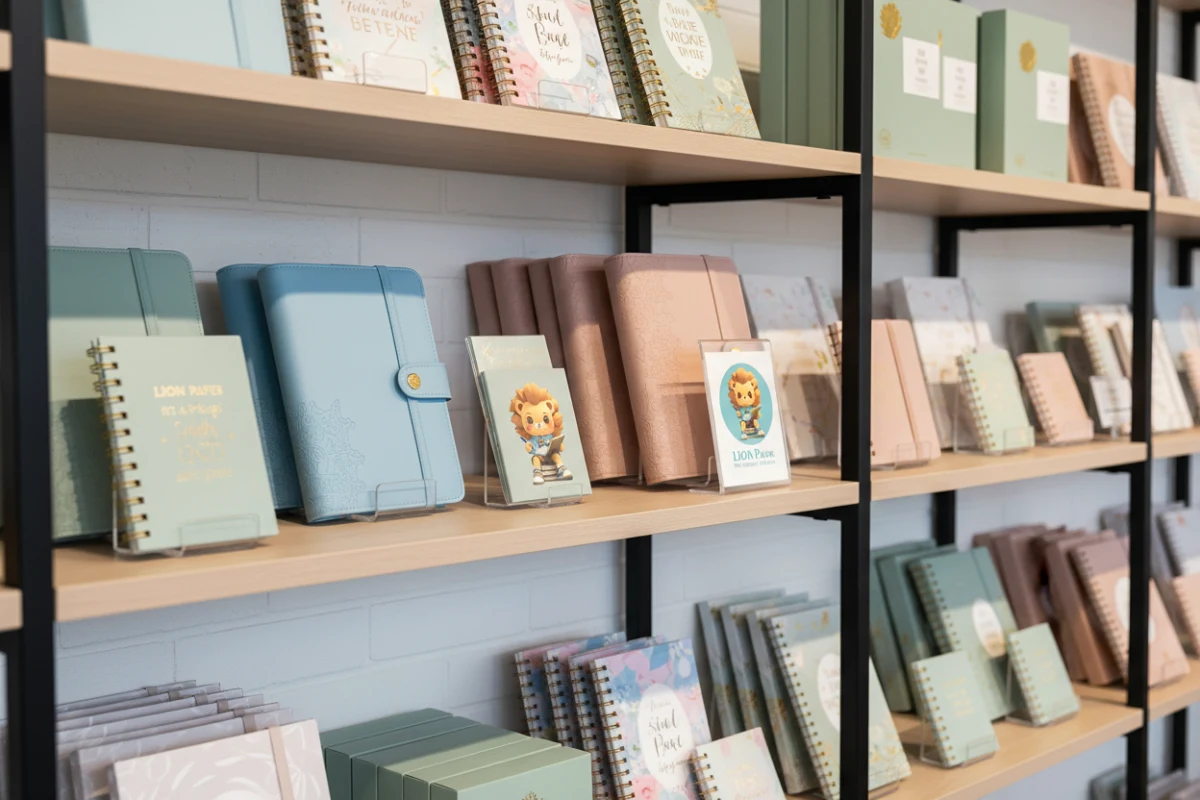
Driving Long-Term Growth with an Integrated Gift Strategy
Expanding your brand's catalog from a single, utility-focused item into a curated, multi-category ecosystem is one of the most effective ways to drive sustainable long-term growth. By executing a deliberate strategy of religious gift collection development, you can elevate your brand's market positioning, maximize retail floor space, and provide your audience with deeply meaningful, beautifully integrated products that enrich their daily practices.
Achieving this vision requires more than just a typical manufacturing vendor; it demands a strategic supply-chain partner with deep category expertise, integrated design-to-manufacturing capabilities, and a reliable global footprint. From the very first design sketch to the final container shipment, Lion Paper Products is committed to helping you build high-value, highly compliant, and trend-forward collections that resonate with your customers and succeed in the global marketplace.
To begin defining your brand's next seasonal release, exploring custom material options, or requesting a physical sample kit, Develop Your Faith-Based Gift Collection with our expert design and supply-chain consulting teams today.